The Crown says the guilty pleas entered by the Christchurch mosque shooter in March 2020 weren’t coerced or involuntary, and there are no grounds to grant him leave to appeal his convictions.
The Court of Appeal in Wellington has heard evidence this week on why the gunman should be allowed leave to appeal and vacate his guilty pleas for the mass shootings at two Christchurch mosques on March 15, 2019.
Brenton Tarrant was jailed for life without parole in 2020 for murdering 51 people and attempting to murder 40 others at the Al Noor and Linwood mosques.
Today, Deputy Solicitor-General Madeleine Laracy told the court a guilty plea was an incontrovertible legal admission of guilt that waived the defendant’s right to a trial and relieved the Crown of proving its case.
Tarrant had given his guilty pleas freely and without coercion, she said.
“Tarrant made an informed choice in circumstances in which he was between a rock and a rock.
“If he pleaded, he was certain of conviction, and if he went to trial, conviction was a certainty,” she said, adding that the evidence against him was more than overwhelming.
He also knew that he would spend the rest of his life in prison, without parole, she said.
She acknowledged that, while this was a terrible and despicable case, it wasn’t a legally difficult appeal because the evidence to support his arguments wasn’t there, and the law was clear.
The onus was on Tarrant to prove his case, and he’d simply failed to do so, she said.
Yesterday, lawyers representing Tarrant, whose names are suppressed, told the three-person panel that the harsh prison conditions to which he was subjected while awaiting trial severely impacted his mental health and meant he was effectively “forced” to change his plea to guilty.
They say his pleas were influenced by oppression to such an extent that they were not given freely.
“If I had another option, I would have taken it,” Tarrant told the court while giving evidence by audiovisual link earlier this week.
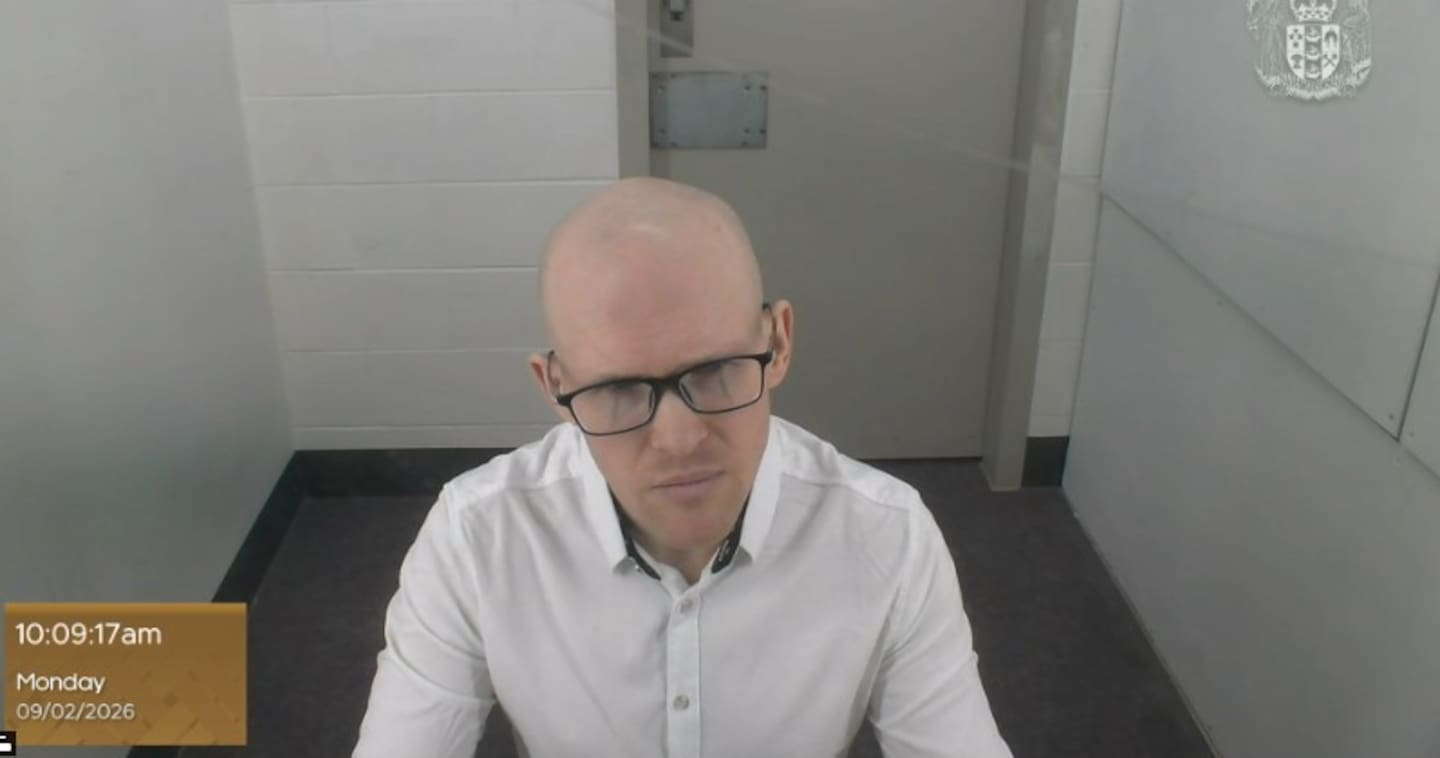
Brenton Tarrant gave evidence at the Court of Appeal on Monday. Photo / Ministry of Justice
Laracy said the evidence given by Tarrant and a psychologist known as Witness B, that Tarrant’s isolation while in prison contributed to the decline in his mental health, fell short and was not capable of meeting the relevant legal tests.
His lawyers had failed to show that he was unfit to plead, or that the guilty pleas he gave were involuntary or coerced, she said.
They had also failed to establish a link between the claimed harsh prison conditions and his decision to plead guilty, or that his prison conditions impacted his mental health to such an extent that it adversely affected his decisional competence.
An ‘unreliable’ witness
Crown prosecutor Barnaby Hawes told the court that Tarrant was an unreliable witness, suggesting his evidence should be treated with great caution.
Hawes said health professionals and his two earlier lawyers, who met Tarrant throughout 2019 and 2020, noted no significant change in his mental health.
Earlier this week, lawyers Jonathan Hudson and Shane Tait, who represented the gunman between March 2019 and July 2020, gave evidence for the Crown, telling the court they were under the impression that Tarrant intended to plead guilty; it was just a matter of when.
Hawes said Tait and Hudson held 40 meetings with Tarrant over this period, lasting up to two hours at a time. They had no concerns about his mental health affecting his ability to enter guilty pleas for instruct counsel.
One of his ex-lawyers told the court that Tarrant’s mental health was consistent across their meetings.
Tarrant’s current lawyers have suggested that an indication he gave his lawyers of a desire to plead guilty in 2019, only to change his mind a couple of days later, was evidence of his fluctuating mental health.
But Hawes submitted it could also be an example of Tarrant’s attempt to control proceedings, or that he’d simply changed his mind. Neither of which was proof of a diminished mental capacity.
Hawes also suggested that, after Tarrant pleaded guilty, he didn’t complain that his guilty pleas were involuntary until well after his sentencing.
The Crown’s submissions will continue this afternoon.
Catherine Hutton is an Open Justice reporter, based in Wellington. She has worked as a journalist at the Waikato Times and RNZ. Most recently, she was working as a media adviser at the Ministry of Justice.

Take your Radio, Podcasts and Music with you
Get the iHeart App

Get more of the radio, music and podcasts you love with the FREE iHeart app. Scan the QR code to download now.

Download from the app stores


Stream unlimited music, thousands of radio stations and podcasts all in one app. iHeart is easy to use and all FREE