
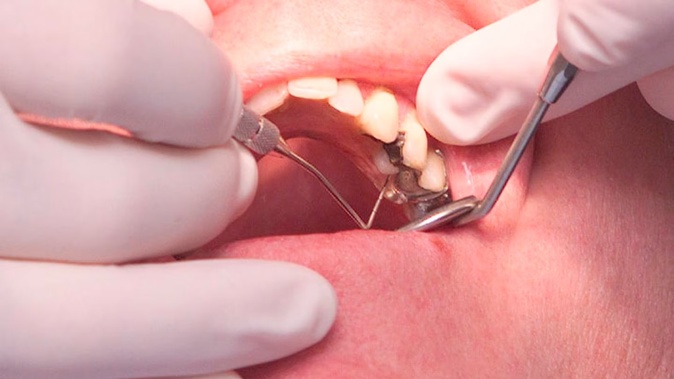
Dentists are raising concerns about the underfunding of a dental contract which provides free treatment for teens, with one clinic charging private patients more to make up the difference.
New Zealand Dental Association president, Dr Dave Excell, said we were once world leading in offering this care for under-18s, but he believes that’s no longer the case.
When students enter high school, free routine dental care is delivered through the Combined Dental Agreement [CDA] until their 18th birthday. The agreement contracts private dentists to deliver services that Health New Zealand pays for per treatment.
In 2024/25, around 235,000 children and young people received services funded through the agreement at a total cost of $71.1 million.
Last year, as part of the annual funding review into the CDA, the Dental Association sent Health New Zealand an independent report on the cost of dentistry.
It claimed the CDA contract was being underfunded by roughly $60 million annually, stating the 19 treatments covered by the agreement were being funded less than individual market rates, with the shortfall being between $20 and $750 per treatment.
It raised concerns about the way funding increases were being measured, most notably it claimed that Health New Zealand wasn’t using the Statistics New Zealand CPI – Dental services index when adjusting CDA rates.
It also pointed out that between 2017 and 2024 the number of dental practitioners delivering CDA services dropped by 10%.
Excell also runs a private dental clinic in Lower Hutt.
“At the moment, what we effectively do is charge our private patients more in order to subsidise [teenagers], because we want to keep seeing the adolescents in our community.
“That’s a goodwill thing. That’s the model that this system is based on. It is based on the goodwill of dentists wanting to provide the care for that cohort of patients,” he said.
Dr Ngareka Bensemann owns a private clinic in One Tree Hill, south of Whangarei and also runs a mobile clinic servicing five secondary schools.
She says annual reviews of the CDA have not delivered adequate funding.“Whenever they do uplifts, it’s by a minimal amount, like one or 2%, if that.
“It’s hard because as dentists and health professionals, we really want to improve the oral health of children and adolescents. But, it’s really difficult when you are trying to run a business and it ends up being at a loss,” she said.
Bensemenn also reports that there has been a rise in complex cases among teens, which she believes contributes to the need for more CDA funding.
“The current model was designed for general dentists to continue care from what the public health service provides to under 13-year-olds. They’re meant to get the children up to scratch, so that when they finish year eight and they move on to the CDA contract, we’re kind of just doing maintenance and the odd treatment to get them through till they’re eighteen,” she said.
According to Bensemann, kids aren’t entering high school with well-maintained teeth.
“There’s a huge amount of care that they need when we see them.
“Sometimes we see some of them come to the clinic, and they’re in the pain state or they haven’t had any treatment for a few years,” she said.
Dr Shash Patel owns five practices across the Bay of Plenty and Waikato regions, as well as running two mobile clinics servicing secondary schools.
Both he and Bensemann say without their private patients, they wouldn’t be able to deliver services to adolescents under the CDA.
“It’s very under-funded, and the scary part now is that it’s getting harder and harder to just keep the dentists to carry on providing this service. Most are running this service as more of a help to the community because the cost of everything has gone up, but this [the funding] has not kept up,” Patel said.
Patel also worries about the declining number of dentists delivering the contract.
“If you look at it just even from a business point of view then every time children are on those chairs, there are adults that can’t take up that time.
“I’ve got 15 clinicians in my team, and even trying to convince them that we need to keep doing this is getting harder and harder,” Patel said.
In the 2025 funding review, Health New Zealand did not accept the report’s findings, as it did not “agree with some of the assumptions and methodology”.
It offered a 3% rise to CDA rates, which the Dental Association rejected, and took Health New Zealand to mediation, where it asked for a review of the contract.
Excell said Health New Zealand never told them what it disputed within the report.
“All of the statistics in the report we got from Statistics New Zealand. We hired an independent consultant from Maven Group to put that report together,” he said.
When asked what exactly it disagreed with, Health New Zealand did not answer the question, instead saying it would convey why it disagreed to the NZDA through its established channels if asked.
Health New Zealand Director Living Well Deborah Woodley said a review of the oral health services for children and young people will take place this year.
“The Oral Health Services Review will provide an opportunity to review models of care, and the funding of community based oral health services from 0 – 17 years.”
However, she said the intent of the review is to provide recommendations within the current funding and policy settings.
Excell isn’t hopeful the review will create meaningful change.
“How are you really reviewing it [the CDA] if you aren’t looking at the funding?” he said.
NZDA met with Health Minister Simeon Brown in November to share the report, and raise concerns around the lack of CDA funding.
Brown said he expects Health New Zealand to engage constructively with stakeholders, including NZDA, and to consider all relevant information as they work to ensure children and young people continue to receive quality oral healthcare.”
“I have asked Health New Zealand for further advice on the issues raised in the NZDA report,” he said.
Troy Matich is a political reporter with Newstalk ZB, working from Parliament’s press gallery. She joined NZME in 2025, previously working for RNZ as a producer for Morning Report.
Take your Radio, Podcasts and Music with you
Get the iHeart App

Get more of the radio, music and podcasts you love with the FREE iHeart app. Scan the QR code to download now.

Download from the app stores


Stream unlimited music, thousands of radio stations and podcasts all in one app. iHeart is easy to use and all FREE


