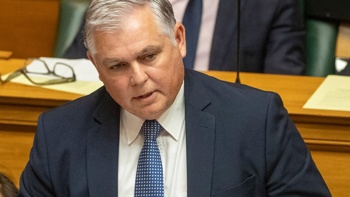
For an accomplished politician, Vanessa Weenink had an unlikely start to life.
One of the National MP’s earliest memories is watching from her family home in rural Marlborough as police cars rushed on to their property to arrest her father. She was just 5 years old.
“My dad was a bit of a character,” she told Newstalk ZB’s Real Life with John Cowan on Sunday night.
“He left home when he was about 14 and went into the forestry service, and had a bit of a rough time there. He was always an entrepreneur and started all sorts of businesses; we had a mussel farm, we had goats, pigs, all sorts of things.
“But then he went into horticulture, as I put it. He was a bit of a pioneer of the cannabis industry – unfortunately, not necessarily on the right side of the law 40-odd years ago.”
That’s when the police arrived, a dog squad in tow, to take her dad and his cannabis plants away.
“That sort of changed him, and changed his outlook on things,” Weenink told Cowan.
“He became very much an anti-authority kind of person – somebody who ended up being on the edges of society because of the fact that he’d been in prison, found it hard to get work and have his own businesses.”
Despite her difficult upbringing, Weenink had what she now recognises as an “idyllic” childhood in the small settlement of Canvastown, west of Picton.
“It was the 80s, we were free-range kids. We jumped on our bikes and went down to the river, went swimming and hunting cockabillies. In the creeks up the back of the house, we’d look for freshwater cod and go hunting eels.
“We had a block of native bush at the back of our property that we would just sort of stroll around in and make huts; we played bull rush at school and had mudslides and all sorts of fun things.”
The absence of her father was keenly felt, but Weenink’s mother – “a hardcore feminist” – raised her to have confidence in her ability.
“It was always instilled in me that I could do anything that I wanted to do as long as I really, truly believed it in myself,” the 47-year-old told Real Life.
“She was an interesting person. She was very creative, really hardy, but at the same time she could be irrational and vulnerable and maddening as a mother – as I think probably all women find their mothers!”
At age 8, there was more hardship for Weenink as she was rushed to hospital.
“I got a horrible infection called osteomyelitis, which is an infection in the bone. I was really quite sick, I had sepsis and had to go to theatre and have my bone scraped out,” she recalls.
“[It was] a huge amount of pain – I was in the hospital for six weeks and the doctors saved my life. They were amazing.”
It was at that moment she decided she wanted to start down the path to be a doctor herself.

National MP Vanessa Weenink during a finance and expenditure select committee hearing at Parliament in 2024. Photo / Mark Mitchell
“I looked at other options when I was in Year 13, I thought about other career paths that I could take – but I realised that there was nothing else that I wanted to do. That was all I wanted to do.”
Weenink enrolled at the University of Otago in her first year out of high school, studying hard to get accepted into medical school, when more tragedy struck.
“The dean of the hall had to call me in and tell me my father had died,” she recalled.
“He was 52, and it was a huge shock because he died suddenly of a pulmonary embolism … I had to try and process that whilst trying to study and concentrate on getting into med school. I probably delayed my grieving process a bit by doing that.”
Despite her grief, Weenink did make it into medical school and several years later graduated, enabling her to work for 20 years as a GP.
She also served in the Army for more than two decades, being deployed as a military doctor on two tours of Afghanistan and one in East Timor. On her second deployment in Afghanistan, a patrol she was part of was hit by an IED (improvised explosive device), though no one was injured.
Weenink says she hasn’t suffered any serious psychological impacts of serving in a warzone, but still has “unbidden” dreams about her deployments and “can be transported there like it’s today”.
Her most intense memories actually come from the Christchurch earthquake in 2011, where she was on the ground at the Pyne Gould Corporation (PGC) building.
“I stayed there as the triage team leader from about 6pm until 4pm the next day. Everyone that managed to get out and came through our triage tent did survive and did okay, but it was a pretty intense situation to be in.
“I can’t forget that. It can’t be erased from my memory, as I know it can’t for many of the first responders who were there on that day.”
Later, a hip operation made her take stock.
“I had seven weeks off work and it gave me time to reassess my life and think about what I wanted to do. I’d been thinking about doing public health and had done a postgraduate diploma in public health.
“I was in the Medical Association and at the same time that went into liquidation … I went into deep thought about it, and decided to do politics. And just as I was thinking of doing it, a friend of mine called me and said, ‘You should become a politician!’”
Weenink took the advice, initially joining the Labour Party in 2017 before swapping to National before the 2023 election. She ended up winning the Banks Peninsula electorate, turning a sure-fire red seat blue for the first time in 27 years.
Weenink says swapping Labour for National came after some serious soul-searching about her values.
“Really, the thing that stood out for me for National in comparison to Labour was that I really believe that people should have independence, that autonomy of thought, and there should be some reward for achievement.”
She says her background has given her the right skills for being an MP.
“One of the key roles for a constituent MP is to listen to people’s stories, to help them figure out what the nature of their problems really are and whether or not there is anything that can be done to help them,” Weenink told Real Life.
“Often, by the time they get to an MP, there isn’t a lot that can be done, but sometimes there are some silly rules or laws that might need to be tweaked or changed, and we can try and do that.
“Sometimes it’s about advocating for them through government departments just to make sure they’re actually getting the services they deserve.”
- Real Life is a weekly interview show where John Cowan speaks with prominent guests about their life, upbringing, and the way they see the world. Tune in Sundays from 7.30pm on Newstalk ZB or listen to the latest full interview here.
Take your Radio, Podcasts and Music with you
Get the iHeart App

Get more of the radio, music and podcasts you love with the FREE iHeart app. Scan the QR code to download now.

Download from the app stores


Stream unlimited music, thousands of radio stations and podcasts all in one app. iHeart is easy to use and all FREE