
Mike Yardley: History’s grip in Old Québec

From the Dickensian atmosphere of glowing lamps and peeling church bells to quaint stone gabled houses, cobblestoned lanes, and horse-drawn caleche, Old Québec City or Vieux-Québec, is unstoppably picturesque. Charles Dickens wasn’t wrong with his summation of the Old City’s appeal: “Splendid views which burst upon the eye at every turn.” It is like a grand, evocative set of gorgeousness, a built landscape spanning 400 years, bestowed with World Heritage protection in 1985. It is the only North American walled city beyond Mexico, underpinning its proud sense of historical continuity. A city that clings to her French-speaking heritage and Gallic traditions. Home to the largest Francophone population outside of France, Québec City is where the dream of New France was born and died.
The Old City comprises the Upper Town, surrounded by fortifications and strutting the craggy heights of Diamond Cape, while the Lower Town is nestled around its base, fanning out from Place Royale. I started my exploratory at this compact and photogenic plaza which the locals consider as the birthplace of French America. It is where the famed French navigator, and father of New France, Samuel de Champlain made his home away from home in 1608, after declaring it French territory. There’s still a bust of Louis XIV, the Sun King, in the centre of the plaza, installed in 1686, which was the town’s bustling marketplace in the 17th and 18th centuries. Commercial activity stagnated in 1860, and the district became rundown and all but abandoned on the grubby edges of the port.
 Lower Town charms. Photo / Mike Yardley
But sixty years ago, the harbourside district was reborn and rehabilitated, with antiques shops, bistros, and chic boutique hotels breathing renewed atmosphere into the plaza. One building houses the Musée de la Place Royale. Here, a 3D movie about Samuel Champlain, huge scale model, and a costume room gives you a taste of the city’s 400-year history. Dominating the square is Notre-Dame-des-Victories, Québec’s oldest stone church, built in 1688 after an inferno razed many Lower Town homes. Built atop the ruins of Champlain’s first outpost, British cannons smashed the church during the 1759 siege, which was faithfully restored four years later. Its paintings, altar, and large model boat suspended from the ceiling, were brought by early settlers to ensure safe voyages. Unsurprisingly, the church is one of the most coveted locations for weddings in Canada. It’s fully booked for the next two years.
Rue du Petit-Champlain is arguably the prettiest street in the city, flanked by impeccably restored merchant houses and fur trading posts, now brimming with bistros, art galleries and handicraft boutiques. Natural-fibre weaving, Inuit carvings, hand-painted silks, local fashion design, and enamelled copper crafts are among the trademark specialties for sale here. The street, which is actually North America’s oldest trading street, absolutely heaves with tourists, so you may well want to get here early morning to beat the crowd crush. Step out on a guided walking tour of the Old City. My enthralling guide Jocelyn was a font of storytelling, spilling the secrets on the city she has called home for 70 years and whose forebears were part of the early French settlement wave.
 Guide Jocelyn holding court. Photo / Mike Yardley
After founding the settlement in the Lower Town, Champlain relocated its heart to the more easily defendable Upper Town, atop Diamond Cape. Originally the two districts were connected by the vividly named Breakneck Staircase, a gut-busting stairway first built in 1635. It was originally built in wood, but the current steel staircase replaced it in 1968. It’s no problem tottering down, but a hell of a thigh-burner clambering back up. Save your energy and opt for the funicular when ascending. I’m a funicular fanatic from way back and Québec cliff-climbing contraption is a classic. It’s actually one of the region’s oldest businesses, hauling humanity between the Upper and Lower Towns since 1879. The funicular coughs you out onto Dufferin Terrace, which occupies the site of the fort and Chateau St. Louis that Champlain founded in 1620.
It was the seat of power for all New France operations in the 1600s, stretching from New Orleans to the Great Lakes, serving as the official residence for the governors of New France, including the British rulers who succeeded them, until it was destroyed by fire in 1834. The governor at the time, Lord Durham, decided to build a sprawling cliff-side wooden promenade on top of the chateau ruins, which has been progressively enlarged ever since. This ginormous boardwalk, which now extends for a kilometre along the cliffs of Diamond Cape, delivers sweeping views across the Lower Town and the St. Lawrence River. I loved strolling along the terrace at night, or grabbing a seat on a bench, backdropped by the soaring turrets of the Fairmont Le Château Frontenac – claimed to be the most photographed hotel in Canada and built on top of the ruins of the old chateau.
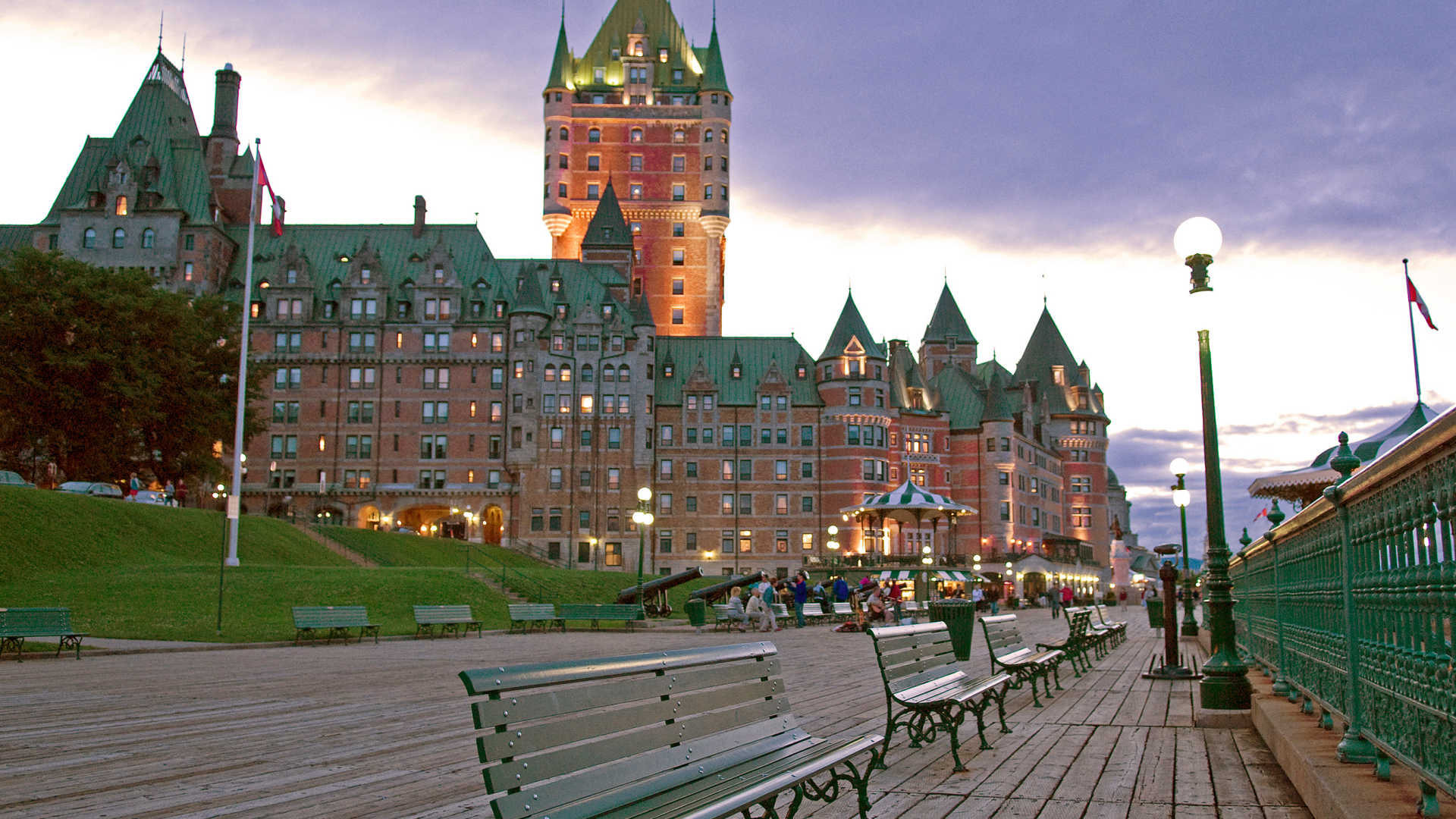 Chateau Frontenac and Dufferin Terrace. Photo / Québec Tourism
Conjuring history and fantasy, it’s a flamboyant neo-French Gothic confection, teeming with spiky turrets scratching the sky. There’s no denying its totemic grandeur is instantly recognisable. I’m a walkover for a good historic hotel and this stirring masterpiece of hospitality is a marquee specimen, spilling forth with proud footnotes from history. In 1939, King George VI and Queen Elizabeth graced Le Château with their presence. At the height of the World War II, the secret military talks, called the Quebec Conferences, were headquartered at the hotel, involving US President Roosevelt and British PM Winston Churchill, in which they thrashed out their Allied battle plans including invading France. Today, 17 of the hotel’s most prestigious suites have officially been named in honour of famous guests who have stayed at the hotel since its opening in 1893, from Alfred Hitchcock to Princess Grace of Monaco.
Coinciding with the dawn of rail’s golden age, the fairy-tale hotel was commissioned by the general manager of the Canadian Pacific Railway in the late 19th century. Even if you’re not staying in-house book a table for afternoon tea. I enjoyed a soothing pot of Imperial Breakfast Tea, as I snacked my way through the most artistically presented slate of moreish treats. Traditional scones, exquisitely presented sandwiches, amuse-bouches, and sweet pastry delights are served on a gourmet tower. Oh, the indulgence.
 Afternoon tea at Chateau Frontenac. Photo / Mike Yardley
Fully fed, I stretched my legs on Dufferin Terrace, gazing across the St. Lawrence River which the glow of the full moon turns the water into the colour of liquid mercury. It famously freezes over in the heart of winter. I was chatting to locals about the extreme winter sport that plays out on this river, as it has for over a century – ice canoeing. Teams of five athletes push, slide, and row specialised heavy canoes through a brutal mix of thick ice chunks and frigid, slushy open water. It’s apparently a stunning spectacle. Lurking beneath the terrace, the archaeological crypt of the chateau’s remains and the seat of power for French and British governors. A major excavation project has revitalised the ruins and the relics, which you can now walk through, underneath the terrace. Highly recommended!
The terrace eventually leads you all the way down to the Plains of Abraham, where a twenty-minute battle changed the course of history and a continent’s destiny. It was on this field that Britain’s General James Wolfe and the French General de Montcalm crossed swords and both died, climaxing in the British army conquering Québec, spelling the death on New France, with the surrender being formalised in Maison Kent. The battlefield is a peaceful city park now, full of winding walking paths and bicycle trails, and a favourite spot for cross-country skiers, come winter. Adjacent to the park, the British reinforced the city’s defences and built a colossal star-shaped fortress, the Citadelle.
 Stepping out on the Terrace. Photo / Mike Yardley
The Duke of Wellington ordered its construction, after repelling the Americans in the War of 1812. The facility has never actually exchanged fire with an invader but still continues its vigil for the state and is home to Québec’s Royal 22e Régiment. It is the largest fortified base in North America still occupied by troops. The regiment turns out in scarlet tunics and bearskin caps for the changing of the guard, daily.
Another radiant Québec encounter is to take a stroll down Rue de Tresor, a small outdoor alley near the Place d’Armes, just past the bright red awnings of La Grand Terasse. Artists have been gathering here to exhibit and sell their work for over 50 years, as if it’s been teleported by the Paris Left Bank. Most of the works showcase Québec scenes – the perfect souvenir to remind you of this stirring pocket of Canada. The city’s motto is “je me souviens” (I remember) and it’s a destination that is supremely endearing. Just outside the city walls, I stayed at the Hilton Québec, a swanky hotel with contemporary and comfortable spaces, a fabulous club lounge and a heated rooftop pool. Be sure to request a high floor and an old city view. The panorama is exceptional and I found myself gazing at wonder at the shifting light.
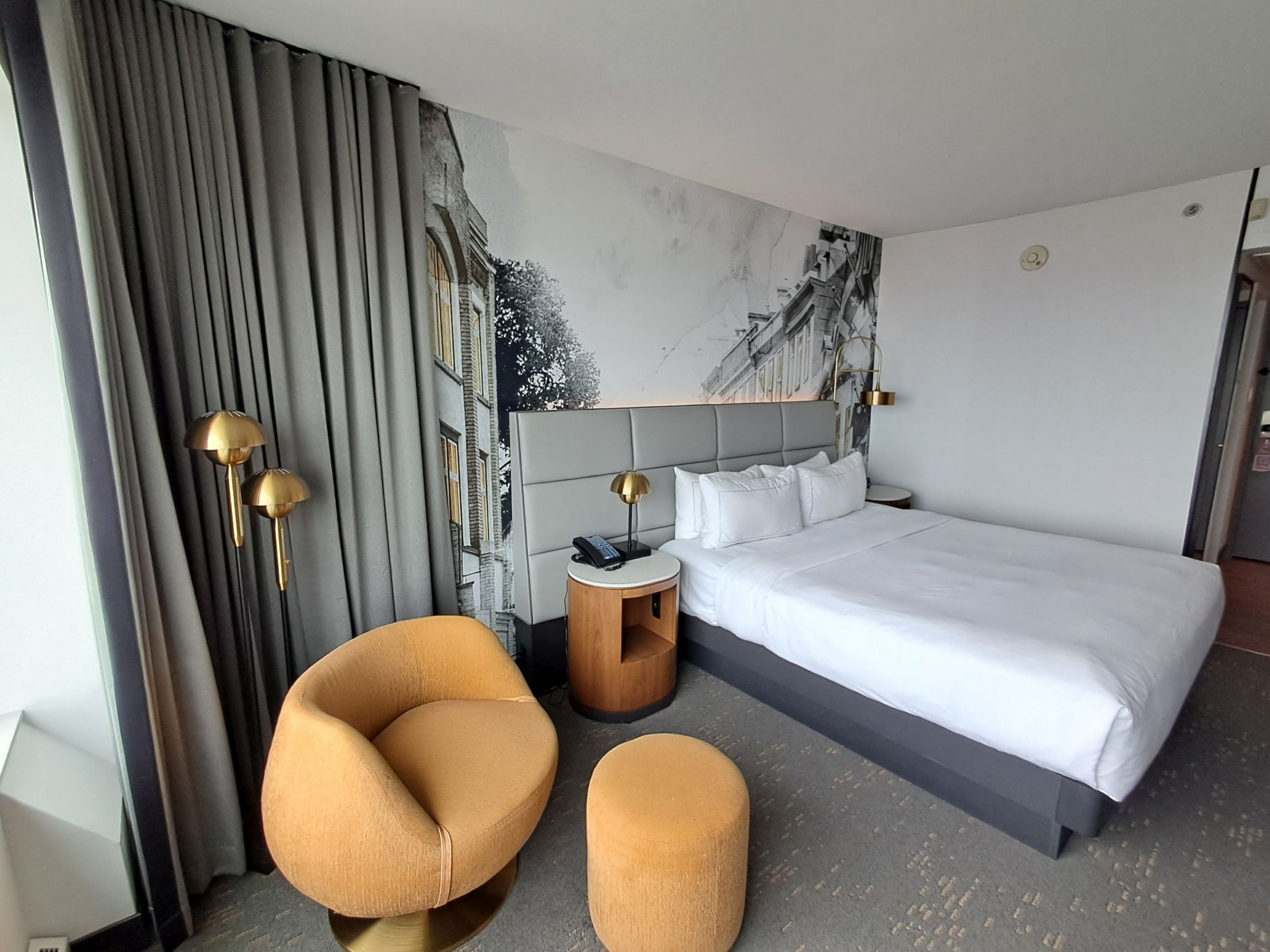 Accommodation at Hilton Québec. Photo / Mike Yardley
Travelling by train is a thrill in Canada, particularly if you’re shuttling between Toronto, Montreal and Québec City. VIA Rail Canada trains are efficient, comfy and equipped with complimentary on board Wi-Fi. Treat yourself to business class and you’ll enjoy a host of comforts. You’ll have access to the business lounge at the main train stations with complimentary beverages; enjoy priority boarding at your convenience; and the supreme sense of space and comfort will accentuate your onboard rail experience. The seats have been refashioned with leather upholstery, along with an adjustable footrest, wide tray table and in-seat recline. Stretch out and relax. Best of all, whether you’re travelling during breakfast, lunch or dinnertime, you get to choose from a hand-picked selection of delicious meals. Plus, the bar service will keep you well lubricated, whether you’re after beer or wine, soft drinks, tea and coffee. For best fares and seats to suit, head to viarail.ca.
Mike Yardley is Newstalk ZB’s resident traveller and can be heard each week on Saturday Mornings with Jack Tame.
Take your Radio, Podcasts and Music with you
Get the iHeart App

Get more of the radio, music and podcasts you love with the FREE iHeart app. Scan the QR code to download now.

Download from the app stores


Stream unlimited music, thousands of radio stations and podcasts all in one app. iHeart is easy to use and all FREE


