
Teacher drowns at Wellington waterfront after being removed from concert

A coronial inquest into the death of Isaac Levings has heard that the teacher was removed from a concert for being intoxicated before he walked out of the venue and fell into the Wellington Waterfront.
The 25-year-old died on April 19, 2023, after showing up to the concert intoxicated, becoming separated from his friends at the event, and eventually drowning in the harbour.
People who spoke on the first day of the inquest included Levings’ family, a friend who he went to the concert with, and a security guard who removed him from the concert.
The last 14 minutes of his life were captured on CCTV cameras and shown in court.
The footage showed Levings swaying as he left TSB Arena at 10.34pm, zig-zagging and stumbling along the waterfront with an unsteady gait.
Levings wandered south past Frank Kitts Park, went behind Whairepo Lagoon and emerged at the west end of Taranaki Wharf before making his way along Te Papa Promenade.
He was wearing a pair of black shorts, bright Reebok trainers and a grey shirt that appeared partially wet with either vomit or sweat.
Levings meandered through many areas that were poorly lit and had no barriers between the walking path and the harbour.
At 10.48pm, a camera caught a shadowy splash in the waterfront near Te Papa, with ripples in the water showing where Levings fell and drowned.
Levings is one of a string of deaths on the capital’s waterfront, with a previous coronial ruling criticising Wellington City Council’s handling of known safety issues in the area.
During an inquest into a different waterfront death in 2021, the council said there was a waterfront fatality every 1.7 years.
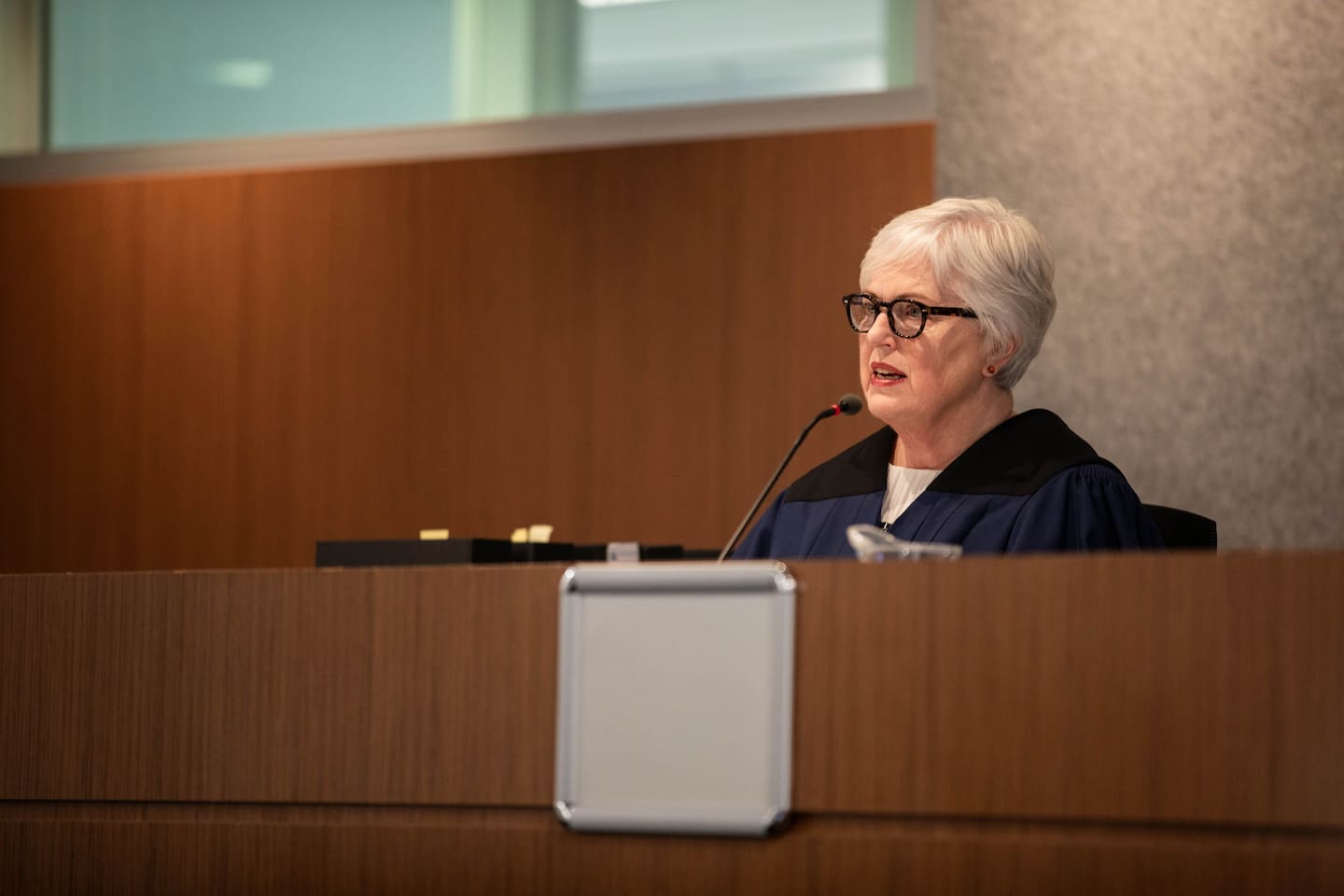
Justice Katherine Greig, the coroner for Isaac Levings' inquest, says the number of deaths at the Wellington waterfront compares unfavourably to those at other waterfronts. Photo / Pool, RNZ
Coroner Katherine Greig began the inquest by acknowledging that Levings was a “young man with much to offer” whose life was “cut tragically short”.
She said the last hours of Levings’ life were a “tiny but tragically important part of his life” but that she would not be passing judgment on the fact he was intoxicated when he died.
Greig said the number of deaths that occurred at the Wellington waterfront “did not compare favourably” to those at other waterfronts.
Counsel assisting the coroner Joshua Shaw said the inquest held two purposes: “One to look backward, the other to look forward”.
He described Levings’ death as an “untimely tragedy” and said the inquest could help determine what could be done to prevent more grieving families like the Levings.
Two days after he drowned, a police diving squad retrieved his body, which had sunk 10m deep in the harbour.
Levings’ autopsy report confirmed the cause of his death was drowning but that being drunk contributed to his death.
His blood and urine alcohol levels showed he was moderately intoxicated.
No recreational drugs were found in his system and he had no reported history of mental health problems.

Tributes for Levings, including a basketball with “you were the most wonderful teacher, we will all miss you” written on it, piled up outside his classroom door at Elmwood Normal School.
Leving’s parents, Charles and Margaret, and his brother James spoke at the inquest, with other family in attendance in the public gallery.
Charles said Levings was “a very easy son and a very easy brother” who was “quick-witted”.
“I’ve never seen him drink to that level, I assumed it had something to do with the friends he met up with,” Charles said.
When he saw the CCTV footage of his son’s last moments, he said Levings seemed like “someone who was very stressed and unable to make rational decisions”.
“The fact he was drunk shouldn’t define him.”
A primary school teacher with a keen interest in sports, Levings was remembered by his colleagues and students’ parents for his love and enthusiasm for the children he taught.
James read out quotes from Levings’ colleagues, who said he had an “infectious enthusiasm for life” and “an extraordinary gift for making people feel seen”.
He teared up while reading messages from Levings’ students, who said he made school a “fun and happier place” and that they still wanted to make him proud.
James said he hoped to understand “how a series of systems, operating within their own responsibilities” had “failed” to keep his brother safe.

Isaac (from left), Margaret, Charles and James Levings.
Levings had originally planned to come to Wellington for a trip to Martinborough, according to Daniel Baylis, his friend who gave evidence today.
He moved his flight forward after Baylis told him of a plan to go to the concert of the band The 1975 beforehand.
Baylis said the pair had been friends for three years after meeting through mutual friends and spoke online almost daily.
He said he and Levings had only met a few times in person because he lived in Taranaki while Levings lived in Christchurch.
Baylis remembered Levings as an “awesome” person who was “very funny” and “always good to get along with”.
The night of the concert, Baylis said he, his sister Alex, Levings and their friend Michael all bought a 10-pack of RTD alcoholic drinks each, which they all drank to completion before the concert.
They walked to the TSB Arena while drunk but coherent and arrived at the venue at 8.30pm.
Once there, Baylis said the group each had at least four glasses of wine to drink.
At 9.30pm, Baylis and Michael went to the bathroom while Alex went further into the mosh pit.
When Baylis came out of the bathroom, Levings was nowhere to be found.
He was not aware Levings had vomited or was taken away by security staff.
“We weren’t worried at this stage,” Baylis said.
He first called Levings on Facebook Messenger at 9.56pm and called him at least five more times to no avail, concluding that his phone might be flat.
The friends walked around looking for Levings before eventually walking back to Michael’s home on Abel Smith St in Te Aro, where the group had been earlier that evening.
Baylis sent Levings his live location and the friends waited up for Levings before passing out at 3am.
Baylis explained the group had planned to head to Michael’s flat post-concert but was unsure if Levings was aware of this plan.
The next morning, another friend of theirs filed a missing person’s report for Levings after calling police and Wellington Hospital and failing to track him down.

Temporary fencing was put up along the Wellington waterfront after Isaac Levings' death but it was taken down late last year. Photo / Mark Mitchell
Louise Torres had been working at security company Red Badge for eight years when she worked at the concert Levings attended.
At 8.30pm she got a call on her radio, alerting her to a man who had thrown up in the crowd and found Levings with visible chunks of vomit on him.
She removed him from the concert and took him to a “chill-out zone”, a designated space for people who needed a break from the crowd because they were too drunk or overwhelmed.
Torres said Levings looked fairly intoxicated to her, with slurred speech and bloodshot eyes, but was not argumentative.
Paramedics asked Levings where his home was but he only grunted, appearing to not want to be there, she said.
Torres said she was called away five minutes later to attend a separate incident.
At some point, Levings left the chill-out zone and exited the venue.
After the concert, Torres did a perimeter sweep of the area outside TSB arena and spotted Levings holding on to a pergola, stumbling around.
She asked him if he was okay but he waved her off.
Torres was “concerned” and asked her colleague, who was more senior, if they should go after him but was told there was not much they could do.
“I had a gut feeling something did not feel quite right,” she said.
The next day, she saw a social media post stating that Levings was missing.
She called police to tell them she had seen him and feared he could have fallen into the water.
Today in court, Torres said she wanted to see fencing installed along the waterfront for large events and for lighting in the area surrounding TSB Arena to be improved.
“When I learned Isaac had died, I was extremely frustrated.
“I was confused why he had been allowed to leave alone,” she said.
Wellington Free Ambulance head of event medical services Daniel Ashcroft said he was told a Red Badge staff member had evicted Levings out of the concert, but was unsure if this meant he was removed from the event or the premises.
Red Badge’s Duty of Care police said that patrons who were too intoxicated should not be removed from the venue unless they have a safe way home or were accompanied by friends.

Roger Calkin with a photo of his late son, Sandy Calkin, who fell into Wellington Harbour and drowned in July 2021.
After Levings’ death, council said it was investigating enhanced edge definition and further fencing to deter people from accessing the wharf edge.
There have been multiple deaths along the waterfront in recent years, including that of 30-year-old Sandy Calkin, whose body was found in the water near Queens Wharf in 2021.
Calkin’s father advocated at the time for balustrades to be installed along the most dangerous parts of the wharf area.
A coroner’s report released last year into that case found the drowning may have been prevented if council had investigated previous deaths and accidents at the waterfront, kept accurate records and heeded experts’ advice.
Greig said in that finding it was clear the council knew about identified safety risks at the waterfront but failed to act on them.
Janhavi Gosavi is a Wellington-based journalist for the New Zealand Herald who covers news in the capital.
Take your Radio, Podcasts and Music with you
Get the iHeart App

Get more of the radio, music and podcasts you love with the FREE iHeart app. Scan the QR code to download now.

Download from the app stores


Stream unlimited music, thousands of radio stations and podcasts all in one app. iHeart is easy to use and all FREE


