Lyttelton Port to invest $821m into wharf and container terminal

Lyttelton Port Company has announced it will invest $821 million in developing a new wharf and container terminal at the South Island’s largest port.
The Te Awaparahi Bay Expansion and Resilience Project is set to deliver a 388m deepwater wharf with four new ship-to-shore cranes, future berth capacity and a 5ha container terminal.
The project will be funded through a combination of debt and equity from Christchurch City Holdings Limited (CCHL).
Lyttelton Port Company (LPC) chairman Barry Bragg said the investment “marked a significant step for the port, Christchurch and the South Island economy”.
“We’ve spent the last decade rebuilding and strengthening the port. Today’s announcement is about creating the capacity, resilience and capability needed for the next generation of South Island trade,” Bragg said.
CCHL chairman Bryan Pearson said the board’s decision to approve LPC’s major transaction followed “due diligence into the project’s strategic need, business case, funding pathway and long-term benefits”.

Lyttelton Port Company will invest $821m in a new Te Awaparahi Bay wharf.
“This approval by CCHL reflects confidence in Christchurch, the South Island economy and our strong belief in Lyttelton Port Company’s role as the South Island’s key international trade gateway,” Pearson said.
LPC CEO Graeme Sumner said the need for investment was clear, with ageing infrastructure, growing demand, larger ships and increasing export volumes creating the “right conditions to move forward”.
“The resilience of some of the container berths is a major driver for the project,” Sumner said.
“Rebuilding them would take at least three years and significantly disrupt container operations.
“Building the Te Awaparahi Bay expansion removes the need to rebuild these wharves and allows the port to continue operating at full capacity.”

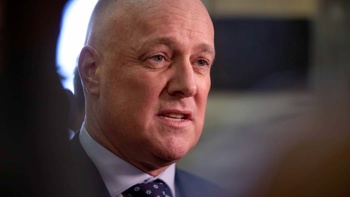
Lyttelton Port CEO Graeme Sumner says the need for infrastructure investment was clear. Photo / Dean Purcell
The new terminal will feature semi-automated gantry yard cranes, helping the port handle more containers in less space, improving the speed and reliability of terminal operations, and supporting safer, more efficient container movements.
When complete, the port’s annual berth capacity will be about 850,000 twenty-foot equivalent units (TEU).
Sumner said the announcement followed strong financial performance for LPC.
“None of this happens without our people. Today’s announcement reflects the commitment, expertise and hard work of generations of LPC staff,” he said.
The project is expected to be complete by 2031.

The project is due for completion in 2031, raising port capacity to 850,000 TEU. Photo / Joseph Johnson
CCHL rejects proposal to lease Lyttelton Port
The announcement comes after CCHL rejected an unsolicited proposal to lease Lyttelton Port’s operating entity, saying it did not warrant further investigation.
It was a decision, the consortium behind the proposal says, that denied Christchurch the chance to consider “two fundamentally different futures” for the port.
The proposal, lodged in June by the Tōnui Consortium, sought to acquire a majority interest in a long-term lease of the port’s operating entity, while keeping the port in public ownership.
The consortium represents global ports operator DP World and three rūnanga: Ngāti Wheke, Ngāi Tūāhuriri and Te Taumutu.
In a statement released in July, CCHL said it had decided not to progress the proposal after assessing it against the council’s expectations and the port’s current performance.
Pearson acknowledged the work undertaken by the consortium.
“Lyttelton Port is a strategic asset for the city and region, and there are diverse groups within our community with interests in its future,” he said.
However, Pearson said the proposal, as presented, fell short.
“Our assessment of the proposal, as presented, is it does not meet the threshold for ongoing consideration and is not sufficiently compelling to warrant further detailed investigation by CCHL, or additional consultation with [the] council, given its letter of expectation.”
The company said Christchurch City Council’s 2026/27 letter of expectation does not support leasing the port and encourages retaining a directly employed workforce.
CCHL said it also considered LPC’s improving operational and financial performance, with advice from the company about the resilience of its infrastructure and the leadership needed to maintain safety and efficiency.
Responding to the decision, Tōnui said it was disappointed Christchurch had “missed the opportunity to compare two fundamentally different futures” for the port.
The consortium said its proposal would have retained public ownership of Lyttelton Port while sharing investment risk and bringing international port expertise to Christchurch.
The consortium also questioned CCHL’s reliance on the council’s letter of expectation, asking whether “there ever was a genuine opportunity for an alternative partnership model to be assessed on its commercial merits?”
CCHL said it would not comment further on the proposal’s details because of commercial and confidentiality considerations.
Take your Radio, Podcasts and Music with you
Get the iHeart App

Get more of the radio, music and podcasts you love with the FREE iHeart app. Scan the QR code to download now.

Download from the app stores


Stream unlimited music, thousands of radio stations and podcasts all in one app. iHeart is easy to use and all FREE