
'Don't come to school': Ex-student accused of shooting threat 'manifesto'


Staff at two Auckland secondary schools woke up to a “manifesto” email claiming to be from a former student.
The email contained threats that home-made guns and a suicide vest would be used to “show them what happens to bullies” and that the author would become “New Zealand’s most deadly mass shooter”.
The March 12, 2025, email caused Waiuku College to go into a lockdown.
“Be ready for a fun surprise in the next few days,” the email, also sent to two police stations and Parliament, warned.
“I can and will get at least 51 kills and beat Brenton Tarrant to become New Zealand’s most deadly shooter.”
The Crown says the email was sent by Tiedan Huo, 22, and that a police search of his addresses the next day found a shotgun, ammunition, and objectionable publications on his computers.
The publications included Tarrant’s 74-page manifesto, his video of the attack, and material from two racially driven American mass shooters.
Huo is now before the courts, standing trial in the Manukau District Court on 12 charges relating to the shooting threats and what was found during the police searches of his homes.
He denies sending the emails or possessing the gun, ammunition and objectionable publications.
The trial began at midday today with an opening statement by Crown prosecutor Gareth Kayes, who started by reading the “chilling email” the two schools received in March last year.
Kayes said the email was titled “Important: Don’t come to school tomorrow” and started with the words “this is my manifesto”.
In the email, the author, claiming to be a former student, outlined the “bullying and harassment” they had been subjected to by teachers and students since coming to New Zealand.
The email said teachers at Waiuku College had treated the author “very poorly” regarding them as a “second-class citizen” because they were Chinese.
“I am going to do something about this now,” the email, shown in court documents, said.
The author claimed to have made their own weapons, including 3D printed guns and ammunition, and a suicide vest to “take revenge on my bullies”.
The email threatened the writer would not die “in a shootout with the police” and could “not be stopped” as they also had “a few” Molotov cocktails, body armour and home-made bombs.
“Even if I am defeated in a gunfight, I will still be able to press the [suicide vest] detonator and kill everyone around me,” the email continued.
Tomorrow morning, the email threatened, the author would go “nice and early” to either Rutherford or Waiuku Colleges to show them “what happens to bullies”.
“I will also make sure the teachers who treated me very poorly get what they deserve,” it continued.

Tiedan Huo, 22, in Manukau District Court today. Photo / Ella Scott-Fleming
Police searches
Kayes said the schools were alarmed and contacted police who were already aware of the threatening email, which had also been sent to Pukekohe and Te Atatū Police Stations and Parliament.
The sender’s name on the email matched that of a former Waiuku student but Kayes said when police met with her there was no evidence the girl was involved.
But when their investigations led to Huo, Kayes said, police searches of his homes provided a “completely different story”.
They first went to a Māngere East, Auckland address, where Huo lived with his mother, and found two laptops and a USB drive in his bedroom.
On all three of those devices, Kayes said, was Tarrant’s manifesto and shooting video, as well as video footage of the 2022 shooting of 10 African Americans in Buffalo, New York, by white supremacist mass murderer Payton Gendron.
Also on the devices, the prosecutor claimed, was a video of a blindfolded man being attacked with a machete, and another manifesto, this time of Floridian mass shooter Ryan Palmeter, who killed three people in 2023.
Finally, Kayes said, there was a video showing an Isis-related terror attack in a Moscow concert hall in 2024 that claimed the lives of 149 people.
All these publications were “extremist material” that, Kayes pointed out, were illegal.
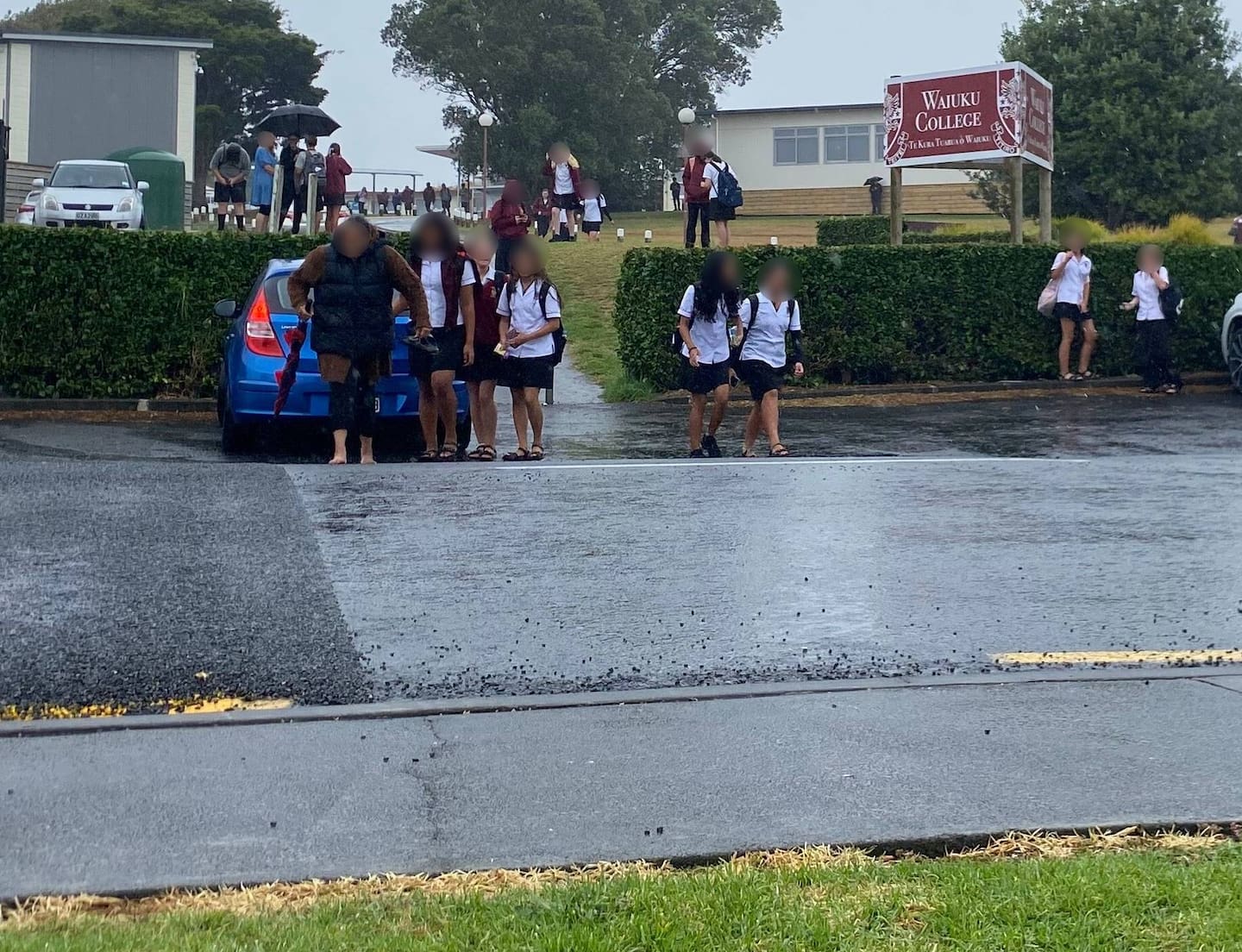
Waiuku College closed for the day after going into lockdown following a threatening email. Photo / Cherie Howie
Then, at the mother’s second address in rural Waikato, where Huo also stayed, Kayes said police found a loaded pump-action shotgun in the accused’s bedroom as well as hundreds of shotgun cartridges and a 3D printer in the house.
The jury had to be sure it was Huo who had sent the threatening emails, Kayes said, but it was not their job to decide whether he was actually going to carry out those threats.
He said one of Huo’s laptops showed evidence of the encrypted email service the threats had been sent from.

Waiuku College principal Stuart Kelly was the first witness at the trial in Manukau District Court. Photo / Cherie Howie
The Crown’s first witness was Waiuku College principal Stuart Kelly, who appeared via audio-visual link and explained what it was like for his school to go into lockdown after receiving the email on March 12, 2025.
Huo’s lawyer Megan Jenkins asked Kelly about the named sender of the email who used to be an international student at his school.
Jenkins asked if Kelly knew the student who was named had filed a complaint against the school because she wanted Chinese language classes implemented that she could understand.
Kelly replied that he did not.
Kelly was also asked if his school had a system for recording bullying complaints, to which he replied they did.
The trial continues.
Ella Scott-Fleming has been a journalist for three years and previously worked at the Otago Daily Times, Gore Ensign and Metro Magazine. She has an interest in court and general reporting. She’s currently based in Auckland covering justice-related stories.
Take your Radio, Podcasts and Music with you
Get the iHeart App

Get more of the radio, music and podcasts you love with the FREE iHeart app. Scan the QR code to download now.

Download from the app stores


Stream unlimited music, thousands of radio stations and podcasts all in one app. iHeart is easy to use and all FREE


